
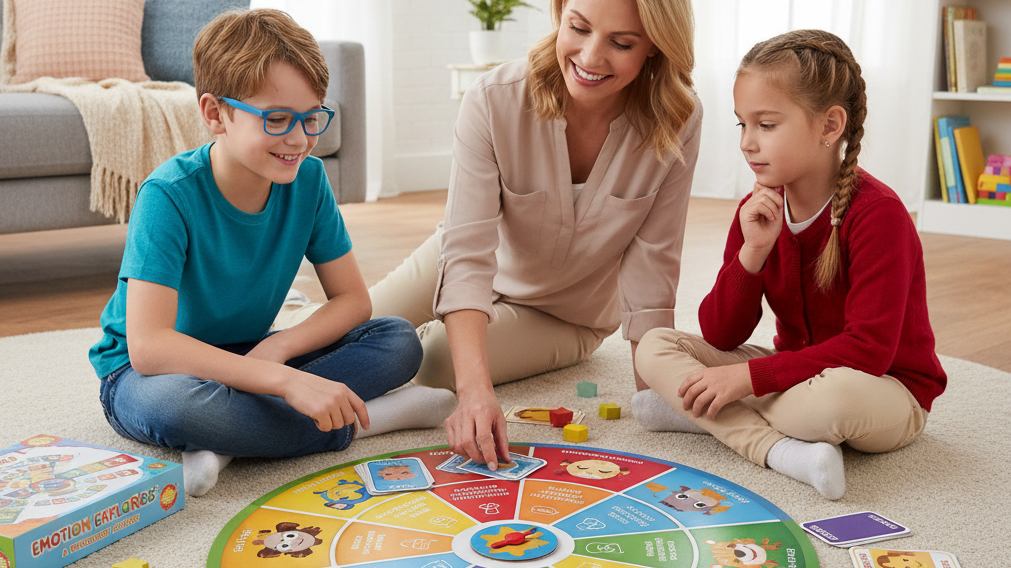
Playing together is one of the most powerful ways for children to learn and connect. For children on the autism spectrum, however, typical play can sometimes feel hard or confusing. That’s why using structured, enjoyable games at home is a fantastic strategy to nurture vital social and communication skills in a comfortable setting. These simple, low-pressure activities focus on the joy of connection, communication, and shared enjoyment — the foundation you’ll want to establish before tackling formal skill targets. Think of play as the bridge to understanding the world together.
To make these social games successful for toddlers with autism, keep them short and predictable. Five to ten minutes of engaged play is much better than twenty minutes of frustration. Clear visual supports, like a “First/Then” board or simple picture cards, help show your child what to expect and what comes next.
Always use a clear start signal (like a special song or a “Let’s Play!” card) and a definite stop signal (like a timer or an “All Done” card). Embedding reinforcement is crucial to sustain motivation — this can be specific praise (“Great job waiting!”), tokens to earn a preferred item, or simply five minutes with a favorite toy immediately after the game. These strategies make play a positive, anticipated experience.
Connection Routines for Daily Moments (Ages 3-8)
Building basic connections is the first step toward social interaction, and parents can easily incorporate these simple routines into their daily lives.
The “Copy Me” mirror play is a beautiful way to encourage engagement and awareness of others. Start by sitting directly across from your child and becoming a mirror for them. Begin with simple actions, such as touching your nose, clapping your hands, or making a big, surprised face. The focus is on your child noticing you and then imitating your movements. This is one of the best games for autistic children because it’s predictable and non-verbal.
Another classic that builds anticipation and joint joy is Peekaboo. You can vary it by using a light scarf or a large blanket. The pause right before the reveal is the key moment for connection — make a silly sound or expression when you reappear. As your child gets older, let them be the one to hide and reveal themselves, building confidence.
Finally, simple name-response games establish a foundational social skill: recognizing and responding to one’s name. Play a gentle tag game where you call their name before lightly tagging them. Alternatively, when rolling a ball back and forth, only roll it when you say their name to ensure they’re looking and ready. These are excellent social games for toddlers with autism because they’re short and highly reinforcing.
Turn-Taking & Joint Attention Foundations
Learning to share attention and wait one’s turn are critical social building blocks that lay the groundwork for meaningful interactions, cooperation, and emotional regulation. These skills help children navigate group settings, follow conversations, and form friendships — essential for autistic children who may find social cues abstract or overwhelming. By breaking these concepts into concrete, repeatable activities, you can create predictable routines that reduce frustration and build confidence over time.
Roll-and-pass board or card games explicitly teach turn-taking. Choose games that are easy to understand and don’t require complex strategy — a simple matching game or a game where you roll a die and move a piece works well. Use visual turn tokens like two different colored blocks (one for “Mom’s Turn,” one for “My Turn”) and matching “my turn/your turn” cards. This clear visual structure reduces anxiety.
“I Spy” game for autistic children helps practice joint attention — the ability to share focus on an object or event with another person. Begin with a large picture book or use objects that are clearly visible in the room. Point and say, “I spy something red!” The goal is for your child to follow your pointing or gaze to the object, or to try pointing out the object you spied on.
The bubble waiting game is a fun way to practice waiting. Blow a small number of bubbles, then pause. Prompt your child to look at you, make a requesting sound, or reach out to you. Only blow more bubbles after they offer a successful prompt. The bubbles serve as a powerful, immediate, and visual reward.
Language & Communication Play
Play offers the perfect context for practicing functional language skills in a fun, non-demanding way. When communication leads to something exciting, kids stay motivated and see the real-world power of words. These activities transform abstract language goals into concrete, rewarding experiences that help autistic children build confidence in expressing needs, answering questions, and using everyday phrases.
Requesting games makes asking for things a natural part of play. Try a “mystery bag” filled with small, interesting toys or snacks. Your child must ask for the bag to be opened, request clues about what’s inside, or label the item once it’s pulled out. This makes communication functional because when they speak, they immediately get something they want.
The “Yes/No” treasure hunt is a silly but effective way to practice answering basic questions. Hide small rewards, such as stickers or pieces of a snack, and then ask simple yes/no questions to guide them: “Is it under the chair?” “Is it in the blue box?” Answering correctly gets them closer to the reward.
For practicing longer sentences, use scripted play sets, such as a toy kitchen or a doctor’s kit. Have sentence strips ready that model functional phrases related to the play. For example, in a kitchen, a strip might say, “I want the plate,” or “Can I have some soup?” You model the line first, then they repeat or point to the strip to practice the phrase in context. These educational games for autistic children focus on language use in real-life scenarios.
Sensory-Friendly Co-Play Ideas
Play needs to be enjoyable and regulated. Including sensory-friendly activities can help keep children calm and engaged during interaction.
Set up tactile stations where you have shared roles. For a kinetic sand relay, one person scoops the sand into a cup while the other person carries the cup to a different location to pour the sand out. With water beads, one person fills a container with a spoon while the other person helps hold the container steady. This clear division of labor promotes co-play without requiring intense eye contact or complex verbal interaction.
Movement circuits are excellent for channeling energy and practicing following directions. Arrange a series of simple gross motor tasks:
- Pillow stepping stones across the room.
- Crawling through a tunnel.
- A slow-tempo freeze dance where you both stop when the music pauses.
Keep the directions simple and model each task clearly. For a calm, regulating activity, as a social game for toddlers with autism, try a sound & light turn-taking game. Dim the room and play quiet, calming music. Use a small flashlight or a gentle light-up toy to pass back and forth. The person holding the light can hold it for a few seconds, then must calmly pass it to the other player. This is a quiet, visual way to practice turns while limiting auditory and visual overload, which can be challenging for some children.
Cooperative Problem-Solving & Pretend Play
Moving beyond simple turn-taking, these activities encourage working toward a shared goal and stepping into imaginative roles. Cooperation builds trust, patience, and the understanding that two heads can achieve more than one. Pretend play adds a layer of creativity that helps children practice perspective-taking, emotional expression, and flexible thinking — skills often targeted in social skills games for autism.

Build-together challenges are perfect for cooperation. Try Lego pattern copying, where you assign roles: one person finds the blocks according to color and size, while the other person places them. Or build a block bridge where one person places the support pillars and the other places the connecting roof pieces. The shared goal (the completed bridge) is the reward.
Use story cubes or puppets to co-create short scenes. Start by modeling a character’s voice and a simple action, then prompt your child to add the next action or line of dialogue. You can also use story cubes (dice with pictures on them) to spark an idea — one person rolls, and the other person starts the story based on the picture. This type of play involves abstract thinking and can be challenging, but it’s a wonderful way to teach social skills games autism programs use to encourage flexibility.
“Helper missions” turn household chores or simple tasks into a cooperative game. Give your child a very clear role that works alongside yours. For example, when taping a piece of paper to the wall, one person holds the paper steady while the other applies the tape. When sorting laundry, one person picks up the blue shirts while the other person puts them in the correct basket.
Track Progress, Generalize Skills, and Include Siblings
Making these games a routine requires thoughtful observation and planning for the future. It’s helpful to keep a quick record of what happened — you don’t need a formal sheet; just a sticky note will do. Mark down three things:
- Engagement (how long they stayed with the game).
- Initiations (did they start a turn or communication on their own).
- Turns taken.
If your child is disengaging quickly, the game for autistic kids might be too long or too hard. If they’re not initiating, you may need to fade your prompts more slowly.
A key step is generalizing the skills they learn. A skill isn’t truly learned until it can be used in new settings. Practice the “Roll-and-Pass” game in the living room one day and the kitchen the next. Use different partners (e.g., Dad, Grandma) and various materials (e.g., a ball, a car). You also need to fade prompts systematically. Are you constantly reminding them, “My turn, then your turn”? Try pointing to the visual card next, then wait silently for them to remember.
If there are siblings, plan for their inclusion. Create a sibling play plan with clear rules. Give the sibling a clear, supportive role, such as “Time Keeper” or “Visual Card Holder.” Rotate choices so that both children feel ownership, and explicitly teach the sibling how to give a helpful prompt (such as a gentle tap on the shoulder) rather than just demanding performance. The whole family benefits when play is planned, predictable, and positive. The goal is always joyful participation, not perfect performance — this approach creates successful games for children with autism.
Leave A Comment